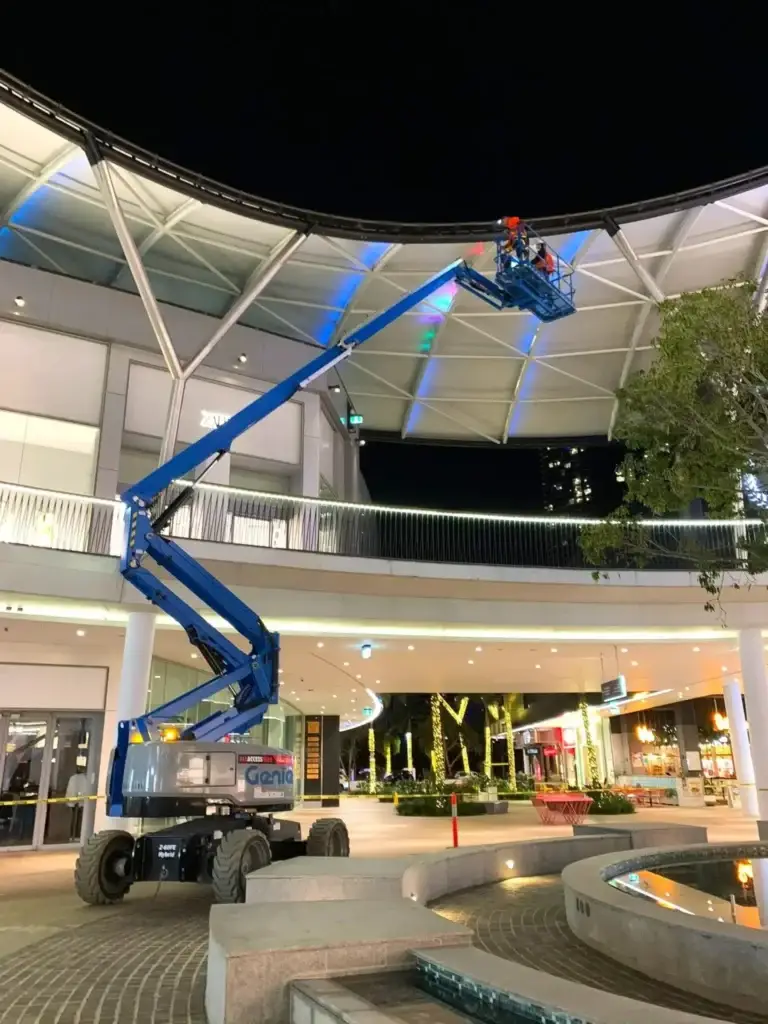

Across Brisbane, Gold Coast and Ipswich, the term cherry picker is commonly used on job sites. It often refers to different types of elevated access equipment, which can lead to confusion when hiring machinery for a project.
A boom lift is a defined type of EWP (Elevating Work Platform) with a powered extending arm designed for vertical height and horizontal reach. A cherry picker is a general term used to describe machines with a work platform or basket, including trailer-mounted units.
All Access Hire supports contractors across Southeast Queensland by matching each project with the right access equipment based on real site conditions, access constraints and compliance requirements.
Why this comparison is critical for construction and maintenance teams in Brisbane
Access equipment directly influences how efficiently work is completed on site.
In Brisbane’s commercial builds, limited access zones require precise positioning. On the Gold Coast, façade maintenance often involves working around architectural features. In Ipswich, construction sites frequently involve uneven ground and larger operating areas.
Selecting the wrong machine can result in limited reach, repeated repositioning and unnecessary delays. With more than 50,000 hires completed, All Access Hire identifies these risks early and provides equipment suited to each environment.
What’s the real difference between a cherry picker and a boom lift?
In everyday use, cherry picker is a broad term. In equipment hire, boom lift defines a specific category of EWP.
A cherry picker usually refers to smaller or trailer-mounted platforms designed for straightforward access tasks. A boom lift refers to machines equipped with articulated or telescopic arms, allowing operators to reach height and navigate around obstacles.
This distinction ensures the correct machine is selected based on reach, movement and site conditions.
Benefits of understanding the difference before hiring
- More accurate equipment selection based on job scope
- Reduced downtime caused by repositioning limitations
- Improved workflow across multi-access tasks
- Stronger compliance with site safety requirements
- Better cost control through correct machine allocation
For projects requiring reach across multiple points or continuous movement, a boom lift is typically the better option:
https://allaccesshire.com.au/boom-lift-hire/
For short-duration or single-position tasks, a trailer-mounted unit such as the TZ34 provides a practical alternative:
https://allaccesshire.com.au/products/tz34-trailer-boom/
Telescopic vs articulated boom lifts
Telescopic boom lifts are suited to open environments where maximum horizontal outreach is required. Articulated boom lifts are designed to work around structures, making them effective in confined or complex areas.
Electric vs diesel power
Electric machines are suitable for indoor environments and sensitive areas where emissions and noise must be controlled. Diesel boom lifts are built for outdoor use, particularly on uneven or demanding terrain.
Working across Brisbane, Gold Coast and Ipswich
Each region presents different access challenges. Brisbane projects often involve tight commercial sites where manoeuvrability and precision are required. Gold Coast jobs commonly focus on maintenance and façade access, where controlled reach improves efficiency. Ipswich sites typically involve construction and infrastructure work, where terrain capability becomes a key factor.
All Access Hire provides equipment aligned with these conditions, ensuring each hire supports the way work is carried out on site.
Certifications and compliance in Queensland
All Access Hire ensures our equipment complies with Queensland’s workplace standards. Every machine is inspected before delivery and maintained to meet operational requirements.
We operate in line with:
- AS 2550.10 – safe use of mobile elevating work platforms
- AS 1418 – design and engineering standards
- WorkSafe Queensland requirements for EWP operation and licensing
This ensures each machine delivered to site supports safe and compliant operation.
Information gain: common mistakes when hiring access equipment
Many hiring decisions fail due to incomplete site assessment. These are the most frequent issues observed across projects in South East Queensland:
- Selecting based on height only, without checking outreach
- Ignoring ground conditions and slope
- Underestimating access width for machine entry
- Choosing electric equipment for outdoor terrain
- Hiring trailer units where frequent repositioning is required
Avoiding these mistakes improves efficiency from day one.
Practical insight: the 3-factor selection method used on site
Before confirming a hire, assess:
- Working height – exact height required for the task
- Horizontal reach – distance from machine position to work area
- Ground conditions – surface type, slope and access
This method allows contractors to quickly narrow down the correct equipment category.
Choosing the right equipment for your job
Maintenance tasks with minimal movement are suited to trailer-mounted cherry pickers. Installation work and confined access benefit from articulated boom lifts. Large-scale construction projects typically require telescopic boom lifts for reach and efficiency. Indoor environments require electric equipment aligned with safety requirements.
All Access Hire provides direct support to define this selection based on your project.
Get in touch with our team and we’ll recommend the right equipment straight away.
Choosing between a cherry picker and a boom lift directly influences productivity, safety and how efficiently work at height is completed.
Frequently Asked Questions
What is the difference between a cherry picker and a boom lift?
A cherry picker is a general term used to describe elevated platforms with a basket. A boom lift is a specific type of EWP with an extending arm that provides controlled vertical and horizontal reach. In equipment hire, the term boom lift is used to define capability and ensure accurate selection.
When should I use a boom lift instead of a cherry picker?
A boom lift is recommended when the job requires horizontal outreach, access over obstacles or frequent repositioning. It is commonly used in construction, façade work and industrial applications where reach and flexibility are required.
What type of boom lift is best for tight access areas?
An articulated boom lift is best suited for tight or complex environments. Its jointed arm allows operators to move around structures and access areas that cannot be reached with a straight boom.
Can I use a cherry picker on uneven ground?
Trailer-mounted cherry pickers can operate on uneven ground if stabilisers are used correctly. For more demanding terrain, a diesel boom lift with rough terrain capability is generally the safer and more efficient option.
Do I need a licence to operate a boom lift in Queensland?
Yes. In Queensland, operating a boom-type EWP with a boom length of 11 metres or more requires a high risk work licence. Operators must also be trained in safe use and site procedures.
What is the safest option for indoor elevated work?
Electric boom lifts are the preferred option for indoor environments. They produce no exhaust emissions and operate more quietly, making them suitable for enclosed or occupied spaces.