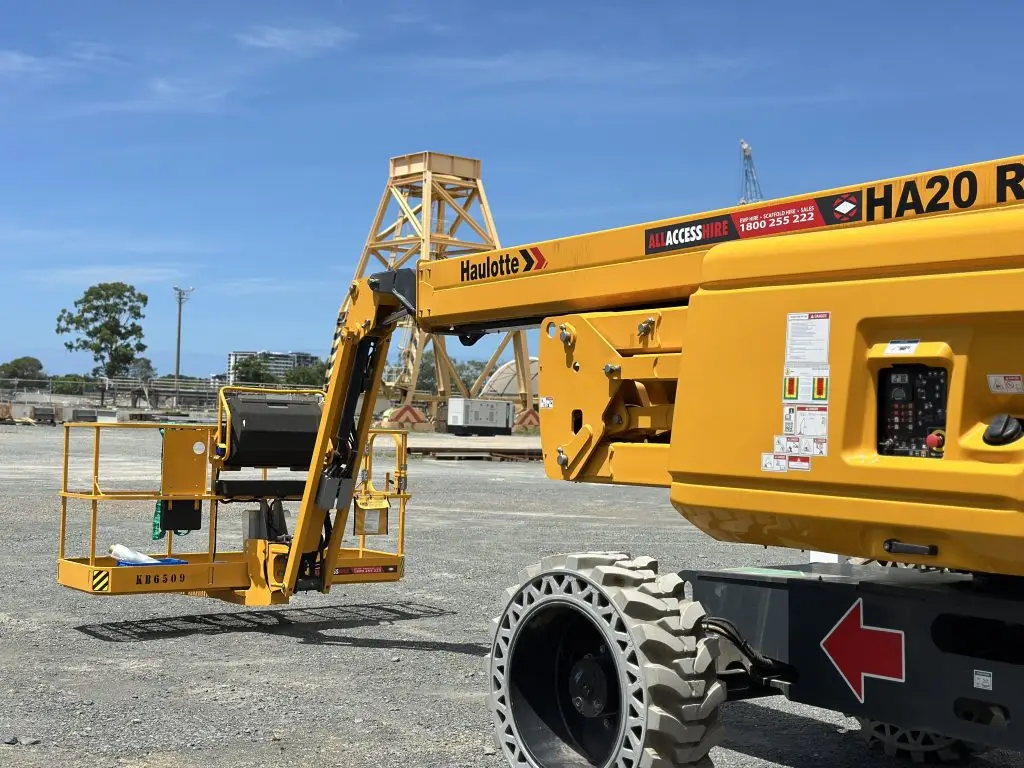

Choosing the right knuckle boom hire in Brisbane involves more than checking maximum working height.
A machine may reach the required height but still be unsuitable if an awning, structural steel, plant equipment or restricted access prevents the platform from reaching the work position.
A knuckle boom, also known as an articulated boom lift or Z-boom, uses hinged boom sections to reach up and over obstacles. A telescopic boom, also called a straight boom, extends more directly and generally provides greater horizontal outreach.
All Access Hire provides both boom types across Brisbane, Gold Coast and Ipswich. This guide explains how their reach profiles differ and which site conditions favour each configuration.
How boom selection affects site access, cost and productivity
Selecting an EWP from working height alone can result in a machine that cannot complete the required task.
Common site restrictions include:
- Fixed awnings or roof edges
- Structural steel
- Existing plant and machinery
- Narrow access points
- Limited space for machine positioning
- Long horizontal setbacks
- Uneven or rough terrain
The wrong machine can lead to additional transport costs, lost labour hours, unnecessary repositioning and delays while replacement equipment is arranged.
For contractors, maintenance teams and facility managers, the starting point should be the required working envelope, including height, horizontal outreach and any obstruction between the machine and the work area.
Benefits of selecting the correct boom lift
Matching the boom configuration to the site can provide:
- Better access to elevated work areas
- Fewer machine relocations
- More efficient platform positioning
- Reduced downtime during the hire period
- Better use of restricted operating space
- Equipment suited to indoor, outdoor or rough terrain conditions
- More accurate equipment selection before delivery
All Access Hire supports customers by considering working height, outreach, site access, terrain and power source before recommending an EWP.
Knuckle boom vs telescopic boom: the main difference
The difference is the path the platform can take towards the work area.
Knuckle boom: up-and-over access
An articulated knuckle boom uses multiple boom sections and pivot points.
This allows the platform to rise above an obstruction before extending towards the target.
Knuckle booms are commonly used for:
- Building façade work
- Structural steel installation
- HVAC servicing
- Electrical maintenance
- Warehouse maintenance
- Shopping centre maintenance
- Signage installation
- Industrial plant access
- Work above awnings and roof structures
All Access Hire’s knuckle boom fleet includes electric, diesel and specialised models for different working environments.
Telescopic boom: longer direct outreach
A telescopic boom lift extends towards the work area in a straighter path.
Straight booms are generally better suited to open sites where there is a clear path between the EWP and the target and greater horizontal outreach is required.
Typical applications include:
- Open construction sites
- Industrial maintenance
- Roofing and structural work
- Infrastructure projects
- External building access
- Large commercial sites
For work areas positioned a substantial distance from the chassis, a telescopic boom can provide greater direct reach.
Knuckle boom hire comparison: Z60 vs S65
The Z60 knuckle boom and S65 straight boom provide a practical comparison because their maximum working heights are relatively close while their reach profiles differ.
The S65 provides approximately 4.9 m more horizontal outreach than the Z60.
The Z60 provides 7.8 m of up-and-over clearance, allowing the platform to reach above and beyond an obstruction.
On an open site with a distant work position, the additional reach of the S65 may be more suitable.
Where an awning, roofline, structural member or fixed plant blocks the direct boom path, the articulated Z60 can provide a more suitable working envelope.
Which boom provides better access around obstacles?
Knuckle booms provide greater flexibility where the platform needs to move around or above structures.
Machine selection should still account for more than boom articulation.
Check:
- Overall chassis width
- Stowed length
- Turning radius
- Tail swing
- Ground clearance
- Platform dimensions
- Machine weight
- Available slewing space
For restricted indoor access, compact electric knuckle booms can also provide a narrower machine profile.
All Access Hire’s Z30 Electric Knuckle Boom, for example, has a published stowed width of 1.19 m and is designed for tight-access applications.
Indoor vs outdoor boom lift hire
Electric knuckle booms for indoor work
Electric articulated booms are suited to enclosed environments where low noise, zero exhaust emissions and restricted access are important.
Common applications include:
- Warehouses
- Shopping centres
- Factories
- Commercial fit-outs
- Lighting maintenance
- Electrical work
- HVAC servicing
Selected electric models in the All Access Hire fleet also use non-marking tyres for finished surfaces.
Where the task requires primarily vertical access rather than horizontal outreach, an electric scissor lift may be a more suitable option.
Diesel booms for outdoor work
All Access Hire provides diesel knuckle booms and telescopic booms with 4WD options for construction, industrial and rough terrain applications.
The required reach profile determines which boom configuration is more suitable.
A straight boom suits open sites where long horizontal reach is required.
A diesel knuckle boom suits work areas where structures interrupt the direct path between the machine and the target.
The individual machine must always operate within the manufacturer’s limits for ground conditions, slope and machine configuration.
Five measurements to provide before hiring a knuckle boom
One of the easiest ways to improve equipment selection is to provide more than maximum working height.
Before booking knuckle boom hire, record these five site measurements.
- Requiredworking height
Measure the actual work position rather than estimating it from the number of building levels.
- Horizontalsetback
Measure the distance between the nearest suitable chassis position and the work area.
This indicates the horizontal outreach required.
- Obstructionheight
Measure any awning, roof, beam, machinery or fixed structure positioned between the EWP and the target.
This measurement helps establish whether up-and-over articulation is required.
- Availableaccess width
Measure gates, doorways, aisles and other restricted access points.
Also consider the space available for turning and boom rotation once the machine reaches its operating position.
- Groundconditions
Identify:
- Slopes
- Uneven ground
- Soft surfaces
- Potholes
- Suspended slabs
- Finished floors
- Site loading restrictions
A machine can have the correct reach profile and still be unsuitable if its dimensions, weight or terrain capability do not match the site.
Working height identifies how high the platform needs to reach. Horizontal setback identifies the required outreach. Obstruction height shows whether articulation is needed. Access width and ground conditions help determine which machines can enter and operate in the available area.
Providing these five details gives All Access Hire a stronger technical brief before equipment is dispatched.
Other equipment for complex sites
Some projects require separate equipment for elevated personnel access and material handling.
All Access Hire provides a broader fleet of access and lifting equipment for construction, maintenance and industrial projects across South East Queensland.
For work requiring primarily vertical elevated access, view electric scissor lift hire.
For longer direct horizontal reach, view telescopic boom lift hire.
Frequently asked questions about knuckle boom hire
What is the difference between a knuckle boom and a telescopic boom?
A knuckle boom uses articulated boom sections to reach up and over obstacles. A telescopic or straight boom extends more directly and generally provides greater horizontal outreach. Knuckle booms suit obstructed or offset work areas, while telescopic booms suit open sites where longer direct reach is required.
What is another name for a knuckle boom?
Knuckle booms are also called articulated boom lifts, articulating boom lifts or Z-booms. These terms describe boom-type EWPs with hinged sections that allow the platform to follow a more flexible path towards the work area.
How high can a knuckle boom reach?
Working height depends on the model. All Access Hire’s articulated knuckle boom fleet includes compact indoor models and high-reach units capable of reaching approximately 43 m. Horizontal outreach, up-and-over clearance and platform capacity also vary by machine.
Do I need a licence to operate a knuckle boom in Queensland?
A WP high risk work licence is required for a boom-type EWP with a boom length of 11 m or more under WorkSafe Queensland’s definition. Advertised working height alone should not be used to determine the licence requirement. Operators also need appropriate training and machine familiarisation.
Can I use a diesel boom lift inside a shopping centre?
An electric EWP is generally better suited to enclosed commercial environments because it produces no exhaust emissions at the point of operation and operates with lower noise. Site ventilation, floor loading, access dimensions and facility requirements must still be assessed before use.
Which boom lift is suitable for rough terrain?
All Access Hire provides diesel 4WD models in both articulated and telescopic configurations. The boom type should be selected according to the required reach profile, while the individual machine must also suit the site’s surface, slope and operating conditions.
All Access Hire provides knuckle boom hire across Brisbane, Gold Coast and Ipswich, with electric, diesel and specialised articulated boom options available for different site conditions.
With more than 50,000 hires completed, All Access Hire supports contractors, maintenance teams and industrial businesses in selecting access equipment against real site requirements.
Send All Access Hire your working height, horizontal setback, obstruction height, access width and ground conditions before booking. Contact the team for a machine recommendation based on your site.