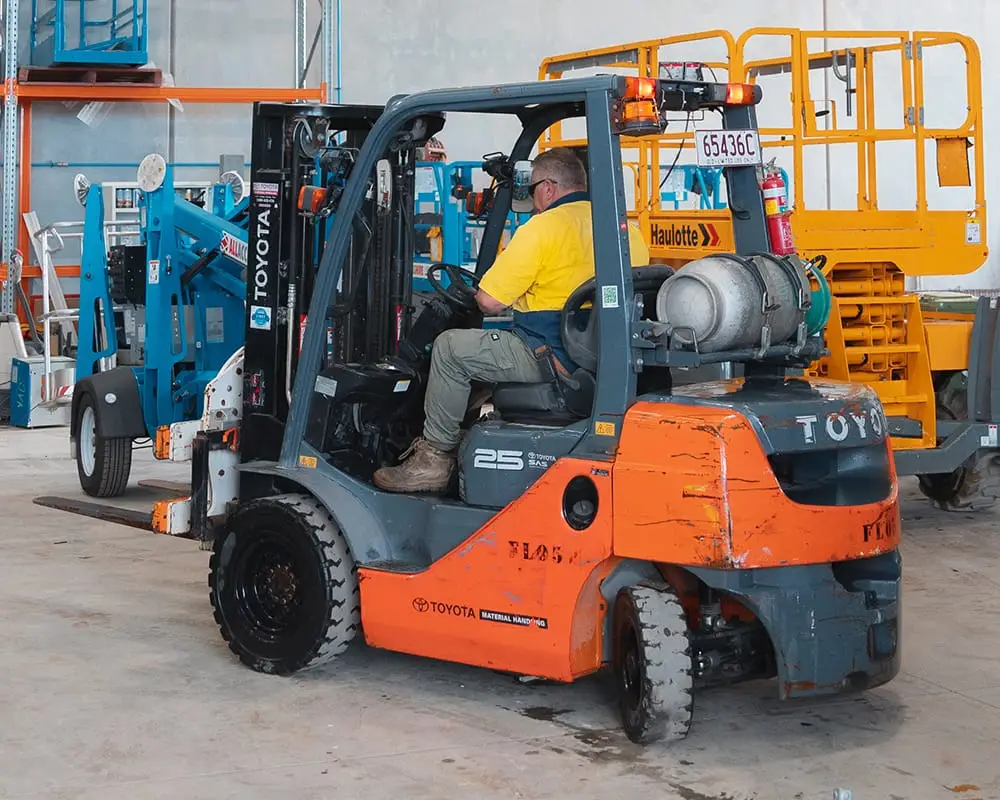

Selecting the right forklift for a construction or logistics site in Queensland requires more than checking load capacity. Power source is one of the key variables that affects runtime, emissions, suitability for confined spaces and total cost over the hire period. This comparison focuses on electric and diesel forklifts, outlining their operational differences so that decision-makers can match equipment to the specific demands of their site.
Operating cost and hire economics
Electric forklifts typically have a lower operating cost per hour. They consume less energy overall and require fewer consumables. There’s no fuel refilling, and wear on engine components is minimal. However, electric units require planned charging cycles and access to power infrastructure. For projects running multiple shifts, downtime due to battery recharge can offset the savings unless backup units or spare batteries are in place.
Diesel forklifts have higher running costs due to fuel consumption and maintenance. Oil changes, filter replacement and exhaust system servicing are part of standard operation. However, diesel units can run continuously over longer shifts without interruption, which may reduce indirect costs related to idle time. For remote projects where charging infrastructure is unavailable, diesel remains a more flexible option.
Emissions and environmental constraints
Electric forklifts produce no on-site emissions. This makes them ideal for indoor environments such as warehouses, supermarkets or distribution centres. Their operation is quiet, and they do not require ventilation planning. On sites with strict environmental controls or sensitive materials (like food storage), electric units offer clear compliance advantages.
Diesel forklifts emit exhaust gases and are not suitable for enclosed spaces without active ventilation. They are designed for outdoor use, particularly in applications where airflow and open space make emissions manageable. Projects in dense urban zones or those operating near residential boundaries may face noise or emission restrictions that limit diesel use.
Torque, power delivery and lifting conditions
Diesel forklifts deliver higher torque at lower revs, making them more suitable for heavy lifting and uneven terrain. Their throttle response provides more control when lifting large or unbalanced loads. This is particularly valuable in construction settings, where forklifts may need to reposition formwork, structural materials or bulk containers over unstable surfaces.
Electric forklifts offer smooth acceleration and precise control at low speeds, which is critical for confined environments. However, they generally have lower maximum torque, especially in entry-level models under 3 tonnes. For applications involving ramps, slopes or heavy-duty cycles, diesel may offer more reliable lifting performance under load.
Indoor vs outdoor performance and environmental resistance
Indoor sites demand low-noise, zero-emission forklifts with compact turning radii. Electric forklifts fit these conditions and are often configured with non-marking tyres, ideal for polished or sealed floors. Their performance is consistent in stable environments but limited when exposed to rain, dust or uneven ground.
Diesel forklifts are built for exposure. Their air intake, tyre design and engine housing are engineered for durability in open-air conditions. They maintain power delivery in variable temperatures, and their mechanical components are protected against debris ingress. For uneven, mixed-terrain or semi-developed construction zones, diesel is the default option.
Application-based recommendation
In urban or indoor environments where noise and air quality are regulated, electric forklifts are the most appropriate choice. Their reduced maintenance, clean operation and precise control make them ideal for enclosed logistics workflows and retail environments.
In outdoor or high-intensity projects involving long hours, load variation and unpredictable weather, diesel forklifts provide the endurance and performance required to keep timelines on track.
All Access Hire supplies both electric and diesel models across multiple capacities, including 2.5T, 3.5T and 5T units. To explore available configurations and match a forklift to your site conditions, visit our forklift hire page or get in touch with our technical team for a tailored recommendation.